
AI as the Recording Studio, Not the Composer
How I used original composition, artistic judgment, and AI-assisted recording to develop a sophisticated musical world for a 33-episode documentary series.
Ending Titles
The Challenge: One Musical Identity Across 33 Episodes
When I was approached to compose music for a documentary series exploring the historical relationship between Eastern and Western Christianity, I was immediately intrigued by the musical possibilities.
The series examines the centuries-long divergence between the Christian traditions of Rome and Constantinople. It moves through history, theology, culture, and the intellectual foundations of two worlds that share a common heritage yet developed distinct identities.
From the beginning, I knew the music needed to do more than accompany the narrative. It needed to help establish the identity of these two worlds while revealing the connections between them.
There was also a considerable production challenge. The documentary was planned as a 33-episode series, and commissioning an entirely original score for every episode would have required substantial resources.
We needed a different approach—one that could maintain a unified musical identity throughout the series while giving the editorial team enough flexibility to work independently.
Our solution was to create a custom musical library specifically for the documentary, then fully score the first 22-minute episode as a model for how that music could be used throughout the series.
Ultimately, we delivered approximately an hour of original music, in addition to the fully scored opening episode.
But the most unexpected development came from how we recorded and produced that music.
Finding the Musical Language
Our first step was a detailed conversation with the director about his vision.
He shared numerous musical references, many of which suggested an ancient, almost timeless atmosphere. We agreed that the score should evoke the historical world of the documentary without attempting a strictly archaeological reconstruction of its music.
I began studying the references alongside my own research into Eastern and Western musical traditions, including their characteristic modes, melodic structures, and instrumental colors.
For the Eastern musical world, I gravitated toward sustained drones, long tones, and ornamental melodic lines. Instruments such as the duduk, flutes, plucked strings, and bowed instruments offered distinctive colors that could suggest an older musical landscape.
For the Western world, I was drawn toward counterpoint and sacred choral writing, particularly the music of Thomas Tallis. Although Tallis lived many centuries after the earliest events depicted in the documentary, his polyphonic language provided an evocative reference for the Western Christian tradition.
I also wanted a musical element that could connect the two worlds.
We settled on the familiar sacred phrases Kyrie eleison and Christe eleison—“Lord, have mercy” and “Christ, have mercy.”
These Greek phrases, also preserved within Western liturgical practice, provided a meaningful common thread. Their presence in both traditions made them especially appropriate for a documentary concerned with shared origins and eventual separation.
The result was a musical vocabulary that could shift between Eastern and Western colors while retaining a recognizable identity across the series.
Composing Before the Technology
My compositional process began much as it does on any other film.
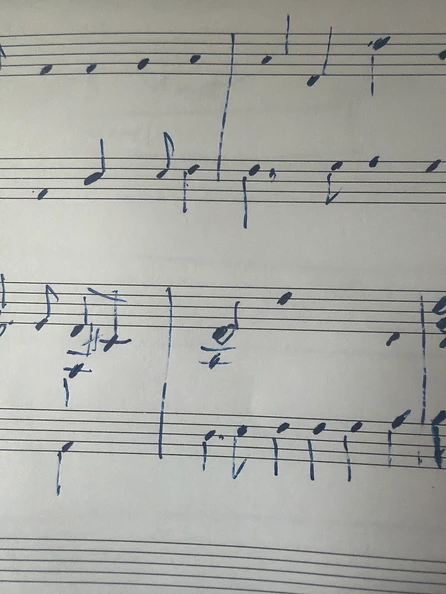
I worked at the piano, hummed and whistled melodic ideas, and wrote fragments into a sketchbook. From there, I developed the material into instrumental mockups using my digital audio workstation.
These were not requests for a computer to invent music. They were compositions with deliberate melodic lines, harmonies, instrumental choices, and musical structures.
The mockups were sometimes less polished than I would ordinarily prepare for a final presentation, but the musical content was intentional.
This distinction became fundamental to the production process.
I wanted to explore whether emerging AI technology could help transform my existing compositions into more sophisticated recordings without substantially altering the music itself.
In other words, could AI function more like a recording studio and a group of performing musicians than a composer?

Developing a New Approach to Recording
Traditional orchestral recording remains one of my preferred ways to realize a film score.
Working with exceptional musicians provides extraordinary control over phrasing, articulation, expression, and the smallest details of a performance. There is something irreplaceable about the interaction between a composer, conductor, musicians, and the recording environment.
But not every film can support that kind of production.
For this documentary, I wanted to achieve a level of instrumental realism and musical sophistication that would ordinarily demand considerably greater recording resources.
We began exploring how AI-assisted production might help close that gap.
What followed was more than 80 hours of research, experimentation, and workflow development.
I discovered that the quality of the results depended enormously on how the original musical material was prepared, how the technology was directed, and how its outputs were evaluated and assembled.
It was rarely a matter of supplying one mockup and accepting the first result.
Some outputs sounded artificial. Others changed musical details I wanted preserved, or introduced dynamics and expressive qualities that didn’t suit the scene.
We experimented, revised our approach, and became increasingly selective.
Sometimes the best result came from combining sections of different recordings. At other times, we retained elements of the original mockup alongside AI-assisted material.
The process remained fundamentally editorial and musical: listening, comparing, rejecting, selecting, and refining.
Over time, we developed a repeatable method that produced substantially more reliable results.
The specific tools and production techniques remain proprietary, but the governing principle is simple: the composition comes first, and the technology serves the composition.
The Breakthrough: Americana Main Theme
One particular cue changed my understanding of what this process could achieve.
We had written a theme for a section exploring contemporary American Christianity and its relationship to the Eastern and Western traditions discussed in the documentary.
I called it Americana Main Theme.
The original mockup already contained the musical material I wanted. The challenge was realizing it with the smoothness, warmth, and sophistication I imagined.
When I heard one of the completed AI-assisted recordings, I was genuinely surprised.
The result preserved virtually all the musical detail of my original sketch while achieving a level of instrumental smoothness and refinement that went far beyond the MIDI mockup.
To my ear, it was almost entirely faithful to the composition.
This was the breakthrough I had been looking for.
The technology had not supplied a new melody or reinvented the harmony. Instead, it had helped realize musical ideas that were already there.
For me, that opened an entirely different way of thinking about AI in film scoring.
Rather than asking technology to compose music, I could use it to help bring my own compositions closer to the sound I had imagined.
Building a Production System
Once we established a reliable process, the next challenge was scale.
We needed to produce a substantial amount of music in a relatively short period while maintaining consistent quality.
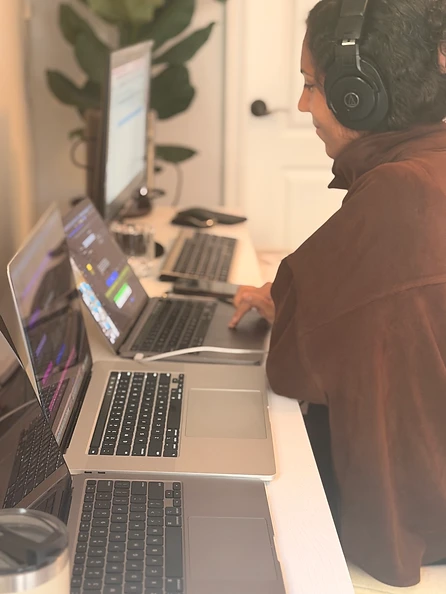
I worked with my assistant to develop a carefully organized production system. We documented our procedures, established quality-control standards, and arranged several computers to operate in parallel.
This allowed composition and production to happen simultaneously.
While I was developing the next melody or instrumental mockup, my assistant could begin processing and evaluating material I had already written.
By the time I finished another sketch, earlier cues were often progressing through the production system.
The parallel workflow meant we could evaluate results continuously rather than waiting for each individual process to finish before beginning the next.
We generated and reviewed a very large volume of candidate recordings, selecting only the material that met our musical and technical standards.
Each final track still required careful preparation, editing, assembly, and quality control.
But once the system was running efficiently, we were able to produce more than an hour of finished original music in approximately ten days.
That achievement was possible not because the human creative process had disappeared, but because we had reorganized how composition, recording realization, and production could work together.

A Custom Musical Toolkit for the Entire Series
The final deliverable was more than a collection of individual cues.
It was a purpose-built musical toolkit for the documentary’s editorial team.
Every piece was developed specifically for the subject matter, musical language, and storytelling needs of the series.
The library included contrasting emotional and historical colors, allowing editors to draw upon a coherent body of music as they worked through subsequent episodes.
We also scored the first 22-minute episode in full.
That opening episode served two purposes: it established the musical identity of the series and demonstrated how the library could be applied to picture.
For the production team, this approach offered considerable flexibility without sacrificing the consistency of a custom score.
For me, it was a reminder that composing for film is not always about writing a separate piece of music for every scene. Sometimes the more valuable creative contribution is designing a musical system that can support the entire production.
What This Means for Independent Filmmakers
I don’t see AI-assisted recording as a universal replacement for traditional music production.
Given the opportunity to work with an exceptional live orchestra in a world-class recording studio, I would still value the expressive possibilities and detailed control that such a session provides.
But most films are made within real financial and scheduling constraints.
For those productions, the choice should not necessarily be between an expensive live recording session and a comparatively limited MIDI mockup.
There is an increasingly interesting space between those options.
When carefully directed by a composer, AI-assisted recording can expand what is possible within a production’s available resources.
It can allow filmmakers to hear original compositions realized with a degree of polish and instrumental sophistication that might otherwise be difficult to achieve.
And, when integrated into a thoughtful production workflow, it can make a substantial body of custom music practical for projects with unusually demanding schedules or extensive editorial requirements.
For this documentary, the result was a distinctive musical identity, a fully scored opening episode, and an extensive original library designed to support the remaining series.
More importantly, it demonstrated a way of working that I expect will influence how I approach future projects.
The technology will continue to evolve. But my responsibility as a film composer remains unchanged: to understand the director’s vision, find the musical ideas that serve the story, and bring those ideas to life with as much artistry and care as possible.
The tools may change. The responsibility for the music does not.
Listen to the Music
Finished recordings from this documentary score. The production’s title will be announced following its public release.
Working on a Film or Documentary?
Every film presents its own musical challenges, whether the project calls for an intimate instrumental score, a large orchestral sound, or an original musical language developed specifically for its story.
I work with directors and producers to create scores that reflect their artistic vision while taking into account the practical realities of production.
If you’re developing a feature film or documentary and would like to discuss its music, I’d welcome the conversation.
— Nathan Pangrazio