
Nathan Pangrazio
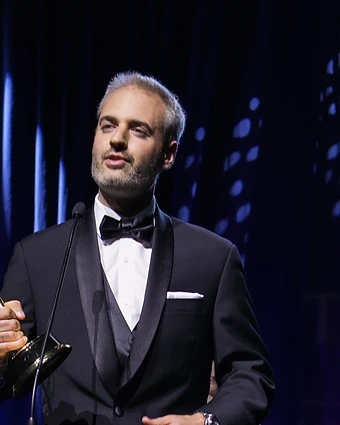
I’m an Emmy Award-winning film composer based in Los Angeles, creating original scores for feature films, documentaries and other narrative projects.
My background brings together three things that have been part of my life for as long as I can remember: composition, classical music and visual storytelling.
Composition Came First
I discovered the keyboard when I was around twelve years old.
Before I really knew how to play it, my instinct was to make up music.
That came before the lessons, before the classical repertoire and before I understood much about composition. I simply wanted to write.
Lessons followed. So did years of piano, studying scores and learning the classical repertoire. But I continued composing throughout all of it.
I also became fascinated with sequencing, synthesizers and multitrack recording. I loved being able to build a piece layer by layer and hear musical ideas develop into something larger.
Looking back, that order has always seemed important to me.
I didn’t learn music and eventually decide to become a composer.
I wanted to compose first.
Everything else gave me more tools with which to do it.
Music and Film Grew Up Together
Film was developing alongside the music.
As a kid, I was constantly making movies. I would organize other kids into productions, think about shots, costumes and effects, and try to figure out how to turn whatever I had imagined into something we could actually film.
I was interested not only in the story, but in how all the pieces worked together.
By my mid-teens, I had begun working more seriously with MIDI and multitrack recording. Suddenly I could combine two things I already loved: writing music and telling stories through film.
That was when I became certain that I wanted to be a film composer.
It still feels like the natural intersection of the things that interested me from the beginning.
A Classical Foundation
I studied Composition and Vocal Performance at Indiana University, completing my studies in 2008.
My musical foundation was deeply classical. I spent years studying repertoire and scores, particularly the music of composers such as Bach, Beethoven and Brahms.
What interested me wasn’t simply the sound of that music.
It was the craft underneath it: harmony, counterpoint, form, thematic development and the ability to take a musical idea and develop it across a much larger structure.
That vocabulary remains important to the way I compose, but it doesn’t determine what a film score has to sound like.
Orchestra may be right for one project. Another may need synthesizers, atmospheric textures, intimate piano, unusual solo instruments or some combination of all of them.
The value of a deep musical foundation is not that every score becomes more complicated.
It is that you have more choices—including the choice to be extremely simple.
Early Commissions and Performances
Before I began working professionally in film, I was already having original concert music commissioned and performed.
As a young composer, I received a commission from the Carmel Bach Festival. My early choral writing also included Absalom, Fili Mi, a work from that period documented in the choral literature.
I also toured Italy and Croatia with I Cantori di Carmel, performing with an ensemble that included my original choral music in its repertoire. The tour itinerary included a concert at the Vatican.
Those experiences taught me something early that has stayed with me throughout my career.
Writing the notes is only the beginning.
A piece has to leave the composer’s room. Musicians have to interpret it. It has to exist acoustically. Eventually, another person has to experience it.
Film music adds another dimension to that process because the music has to become part of something larger than itself.
That is where scoring became particularly meaningful to me.
Serve the Picture Without Surrendering Musical Depth
The film comes first.
That means the director’s vision comes first. The story comes first. Dialogue, pacing, performance and the emotional experience of the audience all matter more than whether a piece of music is impressive by itself.
Sometimes the right score is expansive.
Sometimes the right decision is five notes.
Sometimes the strongest choice is silence.
But restraint doesn’t require the music to become disposable.
Even when a cue sits quietly beneath a scene, I want there to be thought underneath it: harmony, structure, intention and a musical idea worth hearing.
My goal is to find the point where those two things meet—where the music serves the picture completely without giving up its own musical identity.
I want the music to have an opportunity to live on.
A Visual Way of Thinking
My early interest in filmmaking and visual art still affects the way I score.
I don’t experience a scene simply as a piece of footage that needs music underneath it.
I think about the composition of the scene itself: the performances, the frame, the cutting rhythm, the movement, what has already happened in the film and what the audience still needs to experience.
That larger context changes musical decisions.
A scene may be emotional and still need restraint because the film has a more important emotional destination later.
A moment may appear to invite music but become more powerful without it.
Or a musical idea introduced almost imperceptibly early in the film may need to grow over time before the audience finally hears it in its complete form.
That is one of the things I love most about film scoring.
The score isn’t a collection of individual cues.
It is part of the architecture of the film.
The Director Owns the Vision
I consider film scoring a genuinely collaborative art form.
The director owns the vision for the film. My responsibility is to understand that vision as deeply as possible and translate it into music.
When the direction is clear, I want to execute it with complete commitment.
When I genuinely believe another musical idea could make the film stronger, I may offer it as an alternative.
The distinction matters.
My job isn’t to compete with the director for control of the film. But I also don’t believe a good collaborator should withhold an idea that might help simply because it wasn’t the first idea discussed.
The relationship works best when there is enough trust for both things to happen.
The director owns the vision. My job is to understand it deeply, serve it, and contribute another idea when I genuinely believe it could make the film stronger.
The Music Department Should Make the Film Easier
Creative work is only part of the responsibility.
Film production is complicated enough without the music department becoming another source of uncertainty.
I want the scoring process to be organized, responsive and predictable.
The director should know what is happening, what decisions are coming next and whether the score is on schedule.
Feedback should turn into action quickly.
Recording and production should be planned before they become emergencies.
Questions should be anticipated whenever possible rather than discovered at the last moment.
And when something changes—as things inevitably do during filmmaking—I want the response to be practical and calm.
The goal is not simply to deliver excellent music.
It is to run a music department that filmmakers are happy to have on their production.
What I Want the Score to Accomplish
Every film asks something different of its music.
But regardless of style, I generally want a score to accomplish three things.
It should help the audience experience the story more deeply.
It should belong unmistakably to the film it was written for.
And when the film gives the music room to speak, it should contain ideas worth remembering.
That can happen with a full orchestra.
It can happen with electronics.
It can happen with a single instrument.
Scale isn’t the point.
The point is finding the musical language that makes the film feel more completely like itself.
Selected Work
My work includes scores for feature films and documentaries, with projects ranging from intimate dramatic material to orchestral, historical and large-scale cinematic scoring.
- Lew Wallace: Shiloh Soldier, Ben-Hur Bard
An Emmy-winning historical documentary score developed through period research, thematic writing, orchestral production and live soloists.
Explore the Lew Wallace Score → - Face of a Nation
A feature documentary score moving between intimate family storytelling, international architectural worlds and larger orchestral themes.
Explore the Face of a Nation Score →
Indiana University
Composition and Vocal Performance
2008
Working With Nathan
- Feature Film Composer
How I approach musical identity, thematic development and storytelling across a feature-length film.
- The Film Scoring Process
From spotting and early concepts through revisions, recording and final delivery.
- Hiring a Film Composer
What I believe directors should consider when choosing the composer for their film.
- Los Angeles Film Composer
Working with filmmakers in Los Angeles and around the world.